Showing posts with label Quotes. Show all posts

Friday, September 28, 2012

QOTD - Sacraments, How to Change the World

Ever thought the last time you went to confession could change the world? Think again:
The sacraments are defining moments for Christians - and for the world. - Fr. Kurt Stasiak, OSB
Seven Sacraments Altarpiece by Rogier van der Weyden
Royal Museum of Fine Arts, Antwerp

Tuesday, September 4, 2012

The Integral J.R.R. Tolkien

'I threw down my enemy, and he fell from the high place and broke the mountain-side where he smote it in his ruin. Then darkness took me, and I strayed out of though and time, and I wandered far on roads that I will not tell. 
'Naked I was sent back - for a brief time, until my task is done. And naked I lay upon the mountain-top. The tower behind was crumbled into dust, the window gone; the ruined star was choked with burned and broken stone. I was alone. forgotten, without escape upon the hard horn of the world. There I lay staring upward, while the stars wheeled over, and each day was a long as a lofe-age of earth. Faint to my ears came the gathered rumour of all lands: the springing and the dying, the song and the weeping, and the slow everlasting groan of overburdened stone. And so at the last Gwaihir the Windlord found me again, and he took me up and bore me away.
 '"Ever am I fated to be your burden, friend at need," I said
'"A burden you have been," he answered, "but not so now. Light as a swan's feather in my claw you are. The sun shines through you. Indeed I do not think you need me any more: were I to let you fall, you would float upon the wind."
I wish I could claim this writing as my own. We are taken in a realm that is beyond sense while simultaneously being hyper sensory. Am I in a dream? Or is this real? It sounds sort of like Scripture until Saxon-like name appears.

This is the writing of one J.R.R. Tolkien. To the fan-boy, the first paragraph will sound familiar. It is Gandalf speaking of his defeat of the Balrog from Khazad-Dûm in The Two Towers.

(via http://www.theonering.com/ )
In his magnum opus, Tolkien left us something rich and complex. It is not merely an imitable fantasy story nor merely the perfect story to translate into motion picture. It is a myth and myths are powerful. They contain within them much more than mere words and stories and lessons. They contain and communicate Truth.

The excerpt above is my example. Among the mysterious syntax and hazy description comes forth something almost other worldly. For the mind seeking Truth, "naked I was sent back …" has a familiar ring to it. "Do we return to our mother's womb?" Nicodemus asked. "You must be born again of water and the spirt."

"The tower behind was crumbled into dust, the window gone; the ruined star was choked with burned and broken stone." Babel had been destroyed. The veil in the Temple was torn in two. The Light of the world was place in a new tomb hewn from rock.

Tolkien forcibly communicated that he had no intention of writing a 'Catholic' novel, or so I here from many sources. While having never reading those words from his pen, I can see why he would be so adamant. That being said, he did write a Catholic novel - not because it was intended to be one, but because he was Catholic. "Nominal" was not in his religious vocabulary. He was singularly dedicated  Father, Son, and Holy Spirit. He lived that dedication as a father, as a professor, as philologist, and as a writer. When you dedicate yourself to one thing, that one thing permeates all other parts of your life. "I desire that they may all be one as You and I are one." Integrality.

What we have to learn from Tolkien is that to be Catholic is to allow Christ to permeate our entire existence, from breathing to washing the dishes to filling TP reports to calculating the amount of fuel needed for a rover to arrive at the planet Mars.

'"A burden you have been," he answered, "but not so now. Light as a swan's feather in my claw you are. The sun shines through you.

Friday, August 17, 2012

Concupiscence, True Communion, and 'Friends'

I decided to repost my first thoughts posted on blog format. This post originally was written on Monday, June 30, 2008.
It does not correspond to the personal union or 'communion' to which man and woman have been reciprocally called 'from the beginning,' in fact, it is contrary to it, that one of the two persons should exist only as a subject of satisfaction of sexual urge and that the other should become exclusively the object for such satisfaction. Further, it does not correspond to this unity of 'communion'--in fact, it is contrary to it--that both the man and the woman should mutually exist as objects for the satisfaction of sexual urge, and that each of them on his or her own part should be a subject of such satisfaction. Such a 'reduction' of the rich content of reciprocal and perennial attraction among human persons in their masculinity and femininity does not correspond to the 'nature' of the attraction in question. Such a 'reduction,' in fact, extinguishes the meaning proper to man and woman, a meaning that is person and 'of communion,' through which 'the man will... unite with his wife and the two will be one flesh' (Gen 2:4). 'Concupiscence' removes the intentional dimension of the reciprocal existence of man and woman from the personal perspective 'of communion,' which are proper to their perennial and reciprocal attraction, reducing this attraction and, so to speak, driving it toward utilitarian dimension, in whose sphere of influence one human being 'makes use' of another human being, 'using her' only to satisfy his own 'urges.'
Man and Woman He Created Them: A Theology of the Body by Blessed John Paul II
Friends was one of the big sitcoms in the 90's (you can hear the claps from the theme clap-clap-clap-clap). It had a lot of influence on my generation. Yet, this quote from John Paul II puts forward the basic weakness of the series.

There is a total reduction of the relationship between man and woman to one of sexual satisfaction. The two friends who ended up marrying each other began their intimate relationship with sex. When they hid the 'relationship' from the other friends, they where hiding the fact that they were having sex. To my knowledge, which is limited and finite, and possibly wrong, they didn't go out on a 'date' until it was public knowledge that they were dating.

A relationship which ended in marriage was based and grounded upon a sexual relationship, i.e. sand. This is what my generation saw each week, and it is what John Paul II called the utilitarian dimension, wherein the person of the opposite sex is an object for sexual gratification. The ideal in this dimension is mutual sexual gratification, which, to many nowadays, means a basis for a solid marriage.

Monday, August 13, 2012

Is Collecting Bad?: The Fountain Pen and Our Consumerist Culture

To "have" objects and goods does not in itself perfect the human subject, unless it contributes to the maturing and enrichment of that subject's "being," that is to say unless it contributes to the realization of the human vocation as such ... The danger of the misuse of material goods and the appearance of artificial needs should in no way hinder the regard we have for the new goods and resources placed at our disposal and the use we make of them. - Bl. John Paul II Sollicitudo Rei Socialis 28,29

These seem to be contrary statements, but are rather intended to moderate our use of material goods. We live in  a society that idolizes materiality. I feel like I'm preaching to the choir being that most of us realize this. Realizing it is one thing, and not participating in it, is another thing altogether.

Take myself as a poor example. Back in January, I fell in love with fountain pens (they write so much better than ballpoints). They're messy. They are really nice looking, and they leave you open to an endless possibility of inks.

I loved taking notes with them while in my final semester of classes. I actually no longer took notes on my laptop or iPad. Over the course of six months, I have purchased a total of ... 1, 2, 18 fountain pens. My latest purchase is a set with Benedict XVI's signature on it. I got caught by the collector consumer bug, courtesy of Amazon and eBay. 

Now, seriously Kyle what are you going to do with eighteen fountain pens? Well, I use this one for this and this one for that and that one for signing checks and that one for homilies. I still don't use them all. I gave one to my sister. A few ended up being duds and unusable (which in itself proves the point).

Pens hold a certain nostalgia to them. Some of them make really cool fancy lettering. Some of them just look cool (like the one second from the left in the picture that is made from olive wood from the holy land.) 

Pens can contribute, as Bl. John Paul II, to the realization of the human vocation. They can be used to write down thoughts (I write out my homilies because for me, typing requires less energy and less memory). Thoughts are very important in the realization of the human vocation. They can communicate truth and beauty. But "to 'have' objects and goods does not in itself perfect the human subject." In other words, I don't need 17 pens to write my homily. I only need one. 

Where is the line drawn (no pun intended)? Is collecting things a pursuing something that does not bring us closer to God? Are there moral justifications for collecting, whether it be baseball cards, stamps, or fountain pens? Does such a hobby build us up? Dear reader, these are questions for which I do not have an answer. Sound off if you so desire and let me and others know what you think.

Friday, August 10, 2012

Go to Confession and Go Out to the World


True conversion of hearts, which means opening ourselves to the transforming and regenerative action of God, is the 'motor' of all reform and turns into an authentic force for evangelisation. During Confession, the repentant sinner, thanks to the gratuitous action of divine Mercy, is justified, forgiven and sanctified. ... Only those who allow themselves to be profoundly renewed by divine Grace can internalise and therefore announce the novelty of the Gospel.
Bl. John Paul II Dives in Misericordia

Thursday, August 9, 2012

The Contests Between Political Parties and What a Pope Thinks

To these evils we must add the contests between political parties, many of which struggles do not originate in a real difference of opinion concerning the public good or in a laudable and disinterested search for what would best promote the common welfare, but in the desire for power and for the protection of some private interest which inevitably results in injury to the citizens as a whole. - Ubi Arcano Dei Consilio Pius XI
This was written in 1922. It was the encyclical of the pontificate of Pius XI. This is part of what he had to say. I do not normally enter into the realm of politics when I blog, but I read this a few months back and was struck by the force of its truth as well as the appropriateness for our current political situation in the United States. I'll let him speak for himself.
Pius XI in his office (via Wikimedia Commons)

Tuesday, July 10, 2012

Of Hair and Health Care, by GKC


This is a Chesterton essay that acts as the conclusion of his book What's Wrong with the World. Though written over a century ago, it asks just how far the government can go in matters of health and hygiene. It's pertinence to our current situation cannot be overstated.

A little while ago certain doctors and other persons permitted by modern law to dictate to their shabbier fellow-citizens, sent out an order that all little girls should have their hair cut short. I mean, of course, all little girls whose parents were poor. Many very unhealthy habits are common among rich little girls, but it will be long before any doctors interfere forcibly with them. Now, the case for this particular interference was this, that the poor are pressed down from above into such stinking and suffocating underworlds of squalor, that poor people must not be allowed to have hair, because in their case it must mean lice in the hair. Therefore, the doctors propose to abolish the hair. It never seems to have occurred to them to abolish the lice. Yet it could be done. As is common in most modern discussions the unmentionable thing is the pivot of the whole discussion. It is obvious to any Christian man (that is, to any man with a free soul) that any coercion applied to a cabman's daughter ought, if possible, to be applied to a Cabinet Minister's daughter. I will not ask why the doctors do not, as a matter of fact apply their rule to a Cabinet Minister's daughter. I will not ask, because I know. They do not because they dare not. But what is the excuse they would urge, what is the plausible argument they would use, for thus cutting and clipping poor children and not rich? Their argument would be that the disease is more likely to be in the hair of poor people than of rich. And why? Because the poor children are forced (against all the instincts of the highly domestic working classes) to crowd together in close rooms under a wildly inefficient system of public instruction; and because in one out of the forty children there may be offense. And why? Because the poor man is so ground down by the great rents of the great ground landlords that his wife often has to work as well as he. Therefore she has no time to look after the children, therefore one in forty of them is dirty. Because the workingman has these two persons on top of him, the landlord sitting (literally) on his stomach, and the schoolmaster sitting (literally) on his head, the workingman must allow his little girl's hair, first to be neglected from poverty, next to be poisoned by promiscuity, and, lastly, to be abolished by hygiene. He, perhaps, was proud of his little girl's hair. But he does not count.


Upon this simple principle (or rather precedent) the sociological doctor drives gayly ahead. When a crapulous tyranny crushes men down into the dirt, so that their very hair is dirty, the scientific course is clear. It would be long and laborious to cut off the heads of the tyrants; it is easier to cut off the hair of the slaves. In the same way, if it should ever happen that poor children, screaming with toothache, disturbed any schoolmaster or artistic gentleman, it would be easy to pull out all the teeth of the poor; if their nails were disgustingly dirty, their nails could be plucked out; if their noses were indecently blown, their noses could be cut off. The appearance of our humbler fellow-citizen could be quite strikingly simplified before we had done with him. But all this is not a bit wilder than the brute fact that a doctor can walk into the house of a free man, whose daughter's hair may be as clean as spring flowers, and order him to cut it off. It never seems to strike these people that the lesson of lice in the slums is the wrongness of slums, not the wrongness of hair. Hair is, to say the least of it, a rooted thing. Its enemy (like the other insects and oriental armies of whom we have spoken) sweep upon us but seldom. In truth, it is only by eternal institutions like hair that we can test passing institutions like empires. If a house is so built as to knock a man's head off when he enters it, it is built wrong.


The mob can never rebel unless it is conservative, at least enough to have conserved some reasons for rebelling. It is the most awful thought in all our anarchy, that most of the ancient blows struck for freedom would not be struck at all to-day, because of the obscuration of the clean, popular customs from which they came. The insult that brought down the hammer of Wat Tyler might now be called a medical examination. That which Virginius loathed and avenged as foul slavery might now be praised as free love. The cruel taunt of Foulon, "Let them eat grass," might now be represented as the dying cry of an idealistic vegetarian. Those great scissors of science that would snip off the curls of the poor little school children are ceaselessly snapping closer and closer to cut off all the corners and fringes of the arts and honors of the poor. Soon they will be twisting necks to suit clean collars, and hacking feet to fit new boots. It never seems to strike them that the body is more than raiment; that the Sabbath was made for man; that all institutions shall be judged and damned by whether they have fitted the normal flesh and spirit. It is the test of political sanity to keep your head. It is the test of artistic sanity to keep your hair on.


Now the whole parable and purpose of these last pages, and indeed of all these pages, is this: to assert that we must instantly begin all over again, and begin at the other end. I begin with a little girl's hair. That I know is a good thing at any rate. Whatever else is evil, the pride of a good mother in the beauty of her daughter is good. It is one of those adamantine tendernesses which are the touchstones of every age and race. If other things are against it, other things must go down. If landlords and laws and sciences are against it, landlords and laws and sciences must go down. With the red hair of one she-urchin in the gutter I will set fire to all modern civilization. Because a girl should have long hair, she should have clean hair; because she should have clean hair, she should not have an unclean home: because she should not have an unclean home, she should have a free and leisured mother; because she should have a free mother, she should not have an usurious landlord; because there should not be an usurious landlord, there should be a redistribution of property; because there should be a redistribution of property, there shall be a revolution. That little urchin with the gold-red hair, whom I have just watched toddling past my house, she shall not be lopped and lamed and altered; her hair shall not be cut short like a convict's; no, all the kingdoms of the earth shall be hacked about and mutilated to suit her. She is the human and sacred image; all around her the social fabric shall sway and split and fall; the pillars of society shall be shaken, and the roofs of ages come rushing down, and not one hair of her head shall be harmed.

Wednesday, May 23, 2012

Graceful Freedom


The topic of freedom and grace remains one of the most difficult discussions in Christian theology. When John Paul II writes about it, at the heart of the matter is the matter of the heart: what is the heart made for, how can it love, what model does it take? In the post Christian west, we are told that salvation is liberation, and liberation is at the service of the individual. But if freedom and grace are only ordered to the self, then it becomes clear that human dignity means nothing more than autonomy, and salvation is reduced to selfishness. If, however, human freedom exists to be at the service of others, then human beings 'become like God' when they empty themselves for the sake of everybody else. In light of this truth, JP II knew that it was counter-productive to present a God of triumph when, in fact, the mystery of the Christian God is that He Himself is a God of surrender. "In his intimate life, God 'is love,' the essential love shared by the three divine Persons: personal love is the Holy Spirit as the Spirit of the Father and the Son. Therefore he 'searches even the depths of God,' as uncreated Love-Gift. It can be said that in the Holy Spirit the intimate life of the Triune God becomes totally gift, an exchange of mutual love between the divine Persons and that through the Holy Spirit God exists in the mode of gift." (Dominum et Vivificatem, 10.)

In the Holy Spirit, God exists in the mode of gift. God exists in the mode of gift. God exists in the mode of gift! While all the power and progress of this world promises to move mankind toward some infinite pleasure or individual indulgences, Christianity, alone of all the world’s religions and philosophies, presents a man's end as the God Who IS Gift. Who IS selflessness. And when choosing to make this fundamental reality of His existence known to men, He became a man and died, thus fully inaugurating a new law of Gift (or, in Latin, gratia, grace). JP II phrases it this way: "Christ is the centre of the economy of salvation, the recapitulation of the Old and New Testaments, of the promises of the Law and of their fulfillment in the Gospel; he is the living and eternal link between the Old and the New Covenants…Jesus himself is the living "fulfillment" of the Law." (Veritatis Splendor, 16.) This new law of gift is the great revolution of our religion. Its not just about helping people or 'making the world a better place': it’s about making heaven a better place, or rather, making both heaven and earth a place where the King of Gift can actually be given something Himself. For grace (gift) is, after all, how Christians have access to the God who exists in the mode of Gift (grace).

Anyone familiar with Pauline theology or the evangelical applications thereof will know that this is no new theme in Christianity. In her most recent century, fundamentalists and street preachers commonly talked about it within the context of conversion. JP II's himself approaches the topic of grace from the same angle; "The Apostle Paul invites us to consider in the perspective of the history of salvation, which reaches its fulfillment in Christ, the relationship between the (Old) Law and grace (the New Law). He recognizes the pedagogic function of the Law, which, by enabling sinful man to take stock of his own powerlessness and by stripping him of the presumption of his self-sufficiency, leads him to ask for and to receive 'life in the Spirit.'" (Veritatis Splendor, 23) Once we 'take stock' of our own powerlessness, however, we are invited into a new freedom where we extend ourselves beyond the limits of our own person by giving of ourselves for the sake of the Other (‘the Other’=Christ and other humans). Therefore, JP II points out that "Perfection demands that maturity in self-giving to which human freedom is called....Human freedom and God's law are not in opposition; on the contrary, they appeal one to the other. The follower of Christ knows that his vocation is to freedom." (Veritatis Splendor, 17.) No longer are we slaves to the things of this world, to sex, to food, to cloths, to the news, to politics, to even culture itself. All of these things are created good, culture included, but JP II knows that it is important that "man does not become the prisoner of any of his cultures, but asserts his personal dignity by living in accordance with the profound truth of his being." And the truth of man's being is the truth of gift (grace).

Man's graceful freedom can only come through the gospel of Christianity. This gospel is itself Christ's gift: it is not an imposition or a burden. As JP II puts it; "On her part, the Church addresses people with full respect for their freedom. Her mission does not restrict freedom but rather promotes it. The Church proposes; she imposes nothing." (Redemptoris Missio, 39) To accept Christ's word in freedom is to become free to live for others and the Other, for a destiny far greater than the autonomous self could ever provide. "Hence, human activity cannot be judged as morally good merely because it is a means for attaining one or another of its goals, or simply because the subject's intention is good. Activity is morally good when it attests to and expresses the voluntary ordering of the person to his ultimate end and the conformity of a concrete action with the human good as it is acknowledged in its truth by reason." (Veritatis Splendor, 72.)

GKC was fond of saying that you cannot argue with a man unless you can sympathize with his perspective. It’s not simply a matter of understanding his view, but truly feeling the pain he feels. In our day and time, there are many who feel that ‘the Church’ (it matters little whether they mean Roman Catholicism or merely the body of Christians) stands as an institution in contrast with individual freedom. The fact of the matter is that Christianity does, in a very real way, stand in contrast with (if not opposition to) our contemporary conception of freedom. If by ‘freedom’ we mean ‘privacy,’ than Christianity accepts it as only a condition of worldly existence, and a rather negative one at that. In heaven, there will be no privacy for there will be no ability to hold back a part of yourself from anyone else. It would be foolishness to stand before the pearly gates and say to God and the angelic court, the Saints and the Martyrs: “I will share anything with you except this small part. I need it for myself and would feel insecure were I forced to give it away.” Heaven knows nothing of such privacy. The Church admits of the right to privacy as she admits to the right to property: as a temporal affair. That is to say, she concedes to it as temporary, something that will disappear with the coming of the Kingdom. And she prays earnestly, each day, that the Kingdom come sooner rather than later.

In his writing, John Paul II certainly sympathizes with this situation in which Christianity and the world’s opposing ideas of freedom war for men’s hearts. However, he never let this sympathy (which is an emotion) interfere with his love (which is an action). He was willing to admit that complex modern realities, tied into the perennial scandals of humanity-this-side-of-heaven, leave Christianity an easy target of ridicule and suspicion. The question is whether or not we can separate the teachings of Christ from the communion of love he personally established, a communion called the Church. As he says in Veritatis Splendor, "At times, in the discussions about new and complex moral problems, it can seem that Christian morality is in itself too demanding, difficult to understand and almost impossible to practice. This is untrue, since Christian morality consists, in the simplicity of the Gospel, in following Jesus Christ, in abandoning oneself to him, in letting oneself be transformed by his grace and renewed by his mercy, gifts which come to us in the living communion of his Church." (119) In this self-abandonment, the human person breaths again, living not just for herself, but gracefully for the Other.

Tuesday, May 8, 2012

Excitingly Manly


I'm reading the encyclicals of JP II, all of them, back to back, and IT IS THRILLING! Not just interesting. Not just instructive. Not just edifying. Thrilling like a roller coaster is thrilling. Think of the experience of being on a roller coaster. There are the 'dull' moments, usually associated with the loading of the cars or with the slow making-the-way-up to the first or second drop, but after that it is all rush and wind and screaming. Well, that's what reading a JP II encyclical is like. There are sections that are tedious or difficult to follow. They usually concern the setting of the historical context; "In 1890, my venerable successor Leo XIII wrote that..." and you can usually forgive the JP II because 1) like a good actor, he is trying to set the scene and 2) like a good Christian, he is trying to give credit where credit is due. So he lulls us into his pleasant nostalgia of papal documents that we've never heard of or historical situations that we could care less about. And then, with something like a whoop or holler, he brings us to the top of the track, shows us the horizon, and sends us flying on our way right into the heart of the abyss.

And at the heart of every JP II encyclical is the topic of God and man. The sheer substance of his discourse is their relationship, a relationship more dramatic, more mesmorizing and more unexpected than any relationship in any other writing. The trouble is that most contemporary authors ignore this relationship, or if they do write about it, they bring with them all sorts of hang ups, be they intellectual or emotional. The topic of God becomes so specialized, that reading about God and man becomes like an instruction manuel or, worse still, a cheap romance novel (The atheist authors tend to be the worse about this sort of thing, which is why I don't read them much: its not just that they're wrong, but that they're terribly boring). To return to my first statement, it might not be difficult for you to believe that a theologian could find JP II thrilling precisely because I'm already acquainted with his particular language or 'jargon.' That idea is not exactly what I meant to communicate with my first statement, however. What I meant to say is that I, as a human being, as one of the actors in the great drama between God and man, I find these encyclicals thrilling. And you will too.
I know full and well that, in your life time, you've probably read as many papal encyclicals as you have tax forms, looking forward to both exercises with equal anticipation. Therefore, I only ask that you hear me out as I lay before you some of the thrills I have experienced.

1) The Incarnation in JP II's words: "God entered the history of humanity and, as a man, became an actor in that history, one of the thousands of millions of human beings but at the same time Unique!" (Redemptor Hominis)
God as an actor!? Wouldn't that infer that Jesus was just 'playing around' with us during the Incarantion? No! JP II means to shock us with this language (a language, I might add, that we was borrowing from an equally mind-blowing theologian, Hans Urs von Balthasar). God's becoming an actor in human history in no way demeans us, making the world nothing more than a stage, not because the world can't be demeaned, but because God won't be. Therefore, if he became an actor in the drama of human history, as a human, than that means our 'roles' have now been elevated to that of leads! Human beings are now the principle characters in the drama of creation, precisely because God took center stage as one of us. Thus, JP II concludes; "Through the Incarnation God gave human life the dimension that he intended man to have from his first beginning; he has granted that dimension de-finitively---in the way that is peculiar to him alone, in keeping with his eternal love and mercy, with the full freedom of God."

2) 'Justice' in JP II's words; "Although justice is an authentic virtue in man, and in God signifies transcendent perfection, nevertheless love is "greater" than justice: greater in the sense that it is primary and fundamental. Love, so to speak, conditions justice and, in the final analysis, justice serves love." (Dives in Misericordia) Many people think that Christian love 'defeats' justice or 'overrides it.' JP II's words make it clear that justice is not abolished by love, but 're-orders' itself toward love. That is why the Christian must always strive for justice (overcome racism, fight abortion, end wars, etc.) at the service of love (have blacks and whites live together in love, mothers love their children, brothers live in peace with each other, etc). Read in this light, the great tragedy of injustice in NOT what it does to us and how it scars us, but rather what it prevents us from being able to do: love each other. Thus, JP II concludes; "Love, by its very nature, excludes hatred and ill - will towards the one to whom He once gave the gift of Himself: Nihil odisti eorum quae fecisti, 'you hold nothing of what you have made in abhorrence.'"

I give these two examples of the thrill of JP II because they demonstrate perfectly just what type of excitment lies in store for the reader. Many of us feel like we know the gospel. We've heard that Christian thing before. We've gone to Church, gone to Catholic school, watched the movies, sat through CCD, stood through Christmas mass, slept through homilies...you can't tell me anything new. JP II laughs at you! He says, "Ha!, You think you know Christianity? You think you know about Jesus?" And then he takes you on a theological roller coaster ride that is radically different, more inviting, more intimadating and ultimately more exhilrating than the grand majority of 'religious writings' in book stores. He does it all with that signature smirk. But you must be willing to talk with him. Over the next couple of blogs, I plan on sharing more tidbits from these writings of the late, great Holy Father. See them as a chance to take a look at Christianity from the perspective of a man who fought Hitler with plays, fought Stalin with poetry and fought the devil with the sloppy wet kisses he planted on the foreheads of thousands during the course of his pontificate. I think you will find, as I have, a new approach to the gospel, one that is faithful to its Founder because it is obcessed with His personhood and humanity.

Friday, April 13, 2012

Friday Thoughts - Reading Fiction is a Spiritual Exercise

I was going through my day as normal: preparing things for ordination, dealing with schoolwork when I clicked over, vainly of course, to my blog tab on Chrome to see its views for today and realized, "It's Friday!"

Life has gotten out of control for me right now. Lots of things are going on in my life, and I can barely balance them all. The formation staff here has tried to instill in us a rule of life (sort of like a self-imposed Rule like St. Benedict had for his monks without of course the monastic aspects). About a month and a half ago, I made an addition to my rule of life, read a chapter of fiction each day.

Now being in the Utilitarian culture that had formed us this sounds impractical. If I have stuff to do and not enough time to do it, why spend time reading fiction, going off into fiery lands and imagination and stuff. The same could be said of prayer, and indeed, my reason is this. Reading fiction, for me is human formation (buzz word for seminarians, if you don't understand ask you're favorite seminarian, which I understand might very well be me ... cue vanity music).

Fiction helps form and activate the imagination. St. Thomas Aquinas spends part of the Summa Theologiae speaking about the imagination (I q.78 and on from there). He elucidates how it is operative within the union of body and soul. St. Ignatius of Loyola speaks of it with regard to spiritual warfare. It is the battleground where the Holy Spirit insights great gifts of prayer and evil spirits tempt.

Watching film doesn't necessarily activate the imagination. All the images I need are right there in front of me, but with a book, my imagination is hard at work building the words on the page into images in my mind. I will explain with a excerpt from a novella, by Alexander McCall Smith, I just finished called The Perils of Morning Coffee:

She seated herself at the only free table, under one of the large windows, and looked out. The view was of Candlemaker Row, a narrow street that descended sharply towards the Grassmarket. There were angled slate roofs, chimney pots, stone gables, and towering above them, like the set of some improbable opera, the Castle. For a few moments she stared at the scene. The fragility of the city touched her, as it always did; made her catch her breath. And she lived in this: that was what never failed to astonish here. I live in the midst of this beauty.
This is Edinburgh Castle, the "Castle" of
which the character above is referring 
McCall Smith lets the reader in on the beauty of Edinburgh, Scotland. It's ancientness captures the mind, the heart, and the imagination. That street used to house candlemakers. I can imagine people coming from all over the city to get their candles only to head down the hill to the open-field market to purchase the food for that day. Now, not only do I have an image implanted in my mind of Scotland, but a better appreciation of the history of my own city.

Now that my imagination is activated through this simple reading I am more aware when the Holy Spirit introduces Himself and when the evil spirits force themselves in. To read fiction, in some sense, is a spiritual exercise.

Saturday, February 4, 2012

"When all is done, Judgment comes..."

Day of wrath! O day of mourning!
See fulfilled the prophets' warning,
Heaven and earth in ashes burning!

I have a new favorite song: the Dies Irae. Day of wrath, day of mourning. Sounds really heavy, right? And Lent is still over two weeks away. Why not wait ‘til then to talk this up. Better to set that dreary mood after Mardi Gras. That was my initial thought. However, after jamming out to DC*B's version of this ancient hymn for a month, it has made me realize something that's bursting in my chest right now. This song about the dawn of Judgment Day illuminates a part of Christian theology that was once over emphasized and is now largely ignored, a part of our good news that for centuries was seen as nothing more than bad news. Our modern mentality looks upon the last Judgment with a skepticism that disguises a groping fear. Some of the hardcore movies of our time (Terminator, Armageddon, etc) are about preventing judgment day, about erasing it, rather than about finding the courage to face it down. But Judgment Day, in the Christian tradition, ends on a happy note.

Death is struck, and nature quaking,
all creation is awaking,
to its Judge an answer making.

David Crowder purposely wrote his version of the song in C (the happiest of all keys!). That doesn't mean that the song is all sunshine and sparkles and rainbows. It does mean, however, that the very last note we hear resolve the whole hymn is a ‘C.’ If you have a piano or guitar on hand, go ahead and strike a C for me…Very good! It’s quite a happy sound, isn’t it? In the context of a sequence of songs full of dissonant power chords, fiery prophets, peals of thunder and the death of the Son of God, this simple C rings out with profound beauty. The point that Crowder is trying to make after 18 minutes of reflecting on death and judgment is that there is something strikingly beautiful to look forward to. At the end of it all.

Think, good Jesus, my salvation
cost thy wondrous Incarnation;
leave me not to reprobation!

So there was the Holocaust. And there were the Gulags. Now there is apartheid and abortion, greed and global warming. So there will be political infighting, economic unrest, famines and fires, widows and wars, and yet it will not yet be the end (See Matt. 24:6). We know not the day nor the hour, though in our darkest hours we may hope it comes sooner rather than later. Though I do not consider myself a melancholy person, I cannot have an entirely optimistic outlook on the way the world is going. I've certainly never had the chance to be idealistic. My teenage years began with 9/11 and culminated in hurricane Katrina. Whether or not things are really getting any worse, I have no scientific reason to believe that anything short of the Reign of God could make them any better. Yes, scientific: because, as far my study of the sciences (physical, social, liberal) goes, it seems obvious that God would have to come down in order to truly reverse the effects of entropy. The crimes of racism and murder cry out from the ground not just to congress or the UN. They cry to the heavens asking for atonement. My faith brings me real comfort in the knowledge that, when the time comes to judge humanity for the killings of the poor and the Jews, it will be a poor Jewish carpenter sitting on the throne.

Faint and weary, thou hast sought me,
on the cross of suffering bought me.
shall such grace be vainly brought me?

Yet, this is not the only comfort I derive. He is, after all, a truly merciful judge, like us in all ways except sin. In all ways except sin. In all ways that are good, true and beautiful. In all ways except those ways that have led to our own destruction. To this Judge, who is truly God and also truly bone of our bones and flesh of our flesh (recall: He is our spouse as well), we cry out, "Huic ego parce, Deus!”

When all is done, Judgment comes. Spare, O God: have mercy.

As a closing note, I would like to point out how refreshing it is to hear the phrase "Have mercy" resound in praise and worship songs. Normally, the Protestant theology of the authors of this genre steers them away from publically proclaiming this petition. Because of the reasons listed above, I feel that it is oh so necessary to sing it now and always. With all the weariness of this world, my heart cries out for mercy, but it cries out in the key of C!

Pie Jesu Domine,

Dona nobis requiem. Amen.

Wednesday, January 4, 2012

GKC and the Largeness of the Faith

Yet another GKC read! 

This could be considered his commentary on John 6: 68; "To whom, Lord, shall we go." Specifically, he is defending to freedom of the faithful, that when they come to Christ, He enlarges their freedom rather than dismantling it. 

Nothing is more amusing to the convert, when his conversion has been complete for some time, than to hear the speculations about when or whether he will repent of the conversion; when he will be sick of it, how long he will stand it, at what stage of his external exasperation he will start up and say he can bear it no more. For all this is founded on that optical illusion about the outside and the inside which I have tried to sketch in this chapter. The outsiders, stand by and see, or think they see, the convert entering with bowed head a sort of small temple which they are convinced is fitted up inside like a prison, if not a torture-chamber. But all they really know about it is that he has passed through a door. They do not know that he has not gone into the inner darkness, but out into the broad daylight.  It is he who is, in the beautiful and beatific sense of the word, an outsider. He does not want to go into a larger room, because he does not know of any larger room to go into.  He knows of a large number of much smaller rooms, each of which is labelled as being very large; but he is quite sure he would be cramped in any of them. Each of them professes to be a complete cosmos or scheme of all things; but then so does the cosmos of the Clapham Sect or the Clapton Agapemone.  Each of them is supposed to be domed with the sky or painted inside with all the stars. But each of these cosmic systems or machines seems to him much smaller and even much simpler than the broad and balanced universe in which he lives.  One of them is labelled Agnostic; but he knows by experience that it has not really even the freedom of ignorance. It is a wheel that must always go round without a single jolt of miraculous interruption--a circle that must not be squared by any higher mathematics of mysticism; a machine that must be scoured as clean of all spirits as if it were the avowed machine of materialism. In living in a world with two orders, the supernatural and the natural, the convert feels he is living in a larger world and does not feel any temptation to crawl back into a smaller one. One of them is labelled Theosophical or Buddhistic; but he knows by experience that it is only the same sort of wearisome wheel used for spiritual things instead of material things.  Living in a world where he is free to do anything, even to go to the devil, he does not see why he should tie himself to the wheel of a mere destiny. One of them is labelled Humanitarian; but he knows that such humanitarians have really far less experience of humanity. He knows that they are thinking almost entirely of men as they are at this moment in modern cities, and have nothing like the huge human interest of what began by being preached to legionaries in Palestine and is still being preached to peasants in China.  So clear is this perception that I have sometimes put it to myself, as something between a melancholy meditation and a joke.  "Where should I go now, if I did leave the Catholic Church?"  I certainly would not go to any of those little social sects which only express one idea at a time, because that idea happens to be fashionable at the moment. The best I could hope for would be to wander away into the woods and become, not a Pantheist (for that is also a limitation and a bore) but rather a pagan, in the mood to cry out that some particular mountain peak or flowering fruit tree was sacred and a thing to be worshipped.  That at least would be beginning all over again; but it would bring me back to the same problem in the end. If it was reasonable to have a sacred tree it was not unreasonable to have a sacred crucifix; and if the god was to be found on one peak he may as reasonably be found under one spire. To find a new religion is sooner or later to have found one; and why should I have been discontented with the one I had found? Especially, as I said in the first words of this essay, when it is the one old religion which seems capable of remaining new.  I know very well that if I went upon that journey I should either despair or return; and that none of the trees would ever be a substitute for the real sacred tree. Paganism is better than pantheism, for paganism is free to imagine divinities, while pantheism is forced to pretend, in a priggish way, that all things are equally divine. But I should not imagine any divinity that was sufficiently divine. I seem to know that weary return through the woodlands; for I think in some symbolic fashion I have walked that road before. For as I have tried to confess here without excessive egotism, I think I am the sort of man who came to Christ from Pan and Dionysus and not from Luther or Laud; that the conversion I understand is that of the pagan and not the Puritan; and upon that antique conversion is founded the whole world that we know. It is a transformation far more vast and tremendous than anything that has been meant for many years past, at least in England and America, by a sectarian controversy or a doctrinal division.  On the height of that ancient empire and that international experience, humanity had a vision. It has not had another; but only quarrels about that one. Paganism was the largest thing in the world and Christianity was larger; and everything else has been comparatively small. 

Friday, October 28, 2011

Friday Thoughts - Secularism

I have started the mini-mester here at the seminary.  Our professor for the Sacraments of Healing has us reading Bl. John Paul II's Post-Synodal Apostolic Exhortation Reconciliatio et Paenitentia.  I am thoroughly enjoying it.  It is backing up with theology what I have intuited.  Many things have struck me so far but JP II's definition of secularism is spot on, so I want to share it with you.  (For you long time readers, i.e. me, this goes back to the beginning of the blog, sharing quotes)


"Secularism" is by nature and definition a movement of ideas and behavior which advocates a humanism totally without God, completely centered upon the cult of action and production and caught up in the heady enthusiasm of consumerism and pleasure seeking, unconcerned with the danger of "losing one's soul." 
Monday, August 22, 2011

The Eucharist in the Apostolic Fathers Part Four: The Didache


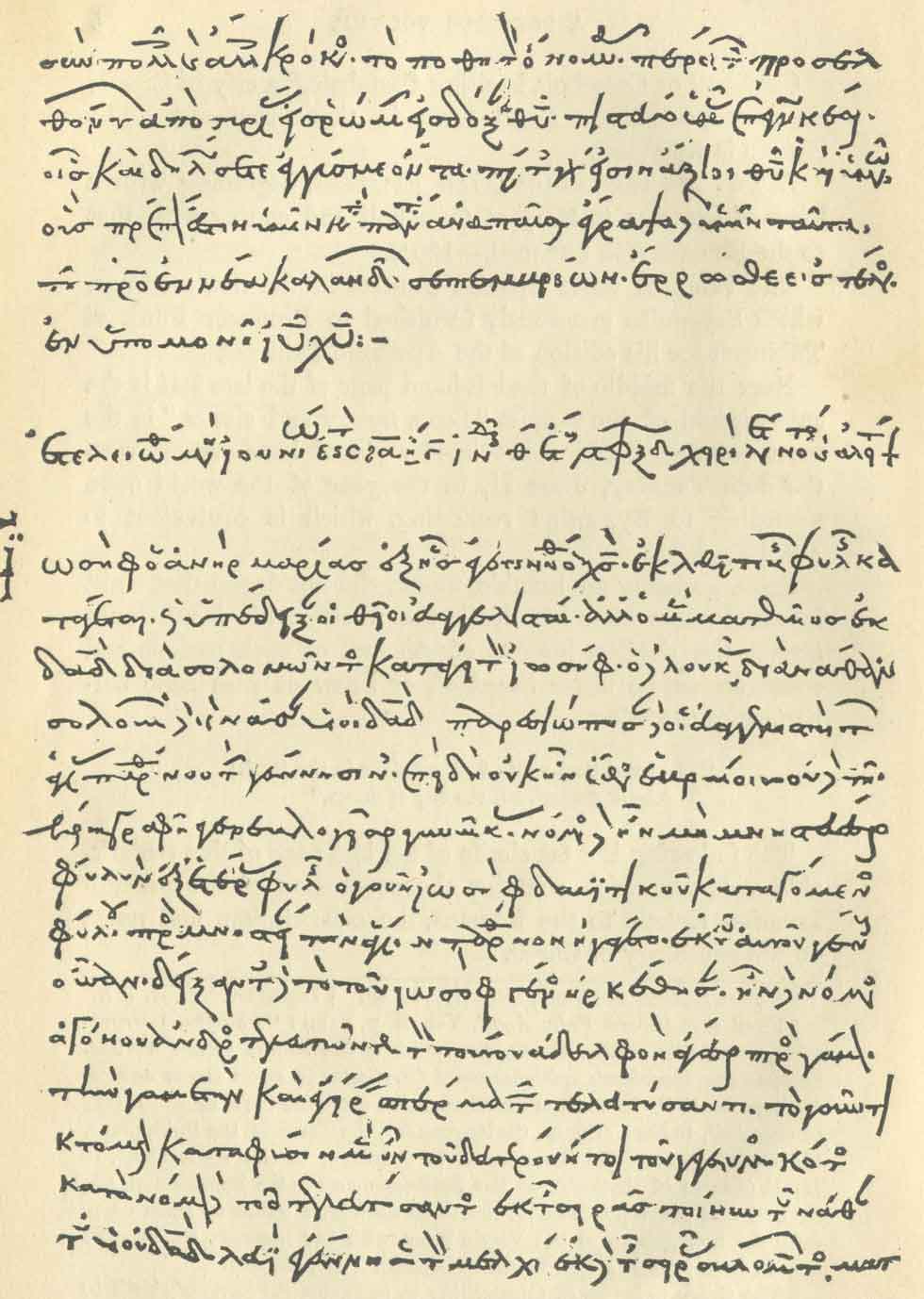
This is the final installment of this little followed series.  Today we look at the Didache (Ignatius press' catechetical series might come to mind, it follows in the footsteps of the early Church catechetical document).  The Didache is an interesting document that was rediscovered on one and half centuries ago.  Previously there were only excerpts in the writings of the Church Fathers.  It is was highly reverenced and considered as great source of early Christian life   There are three Eucharistic chapters, nine, ten, and fourteen.  

Chapter 9 can be seen as the offertory rite of the early church.  If one were to compare chapter nine with the offertory rite in the Ordo Missae there are definite similarities. The Ordo Missae says “Blessed are you, Lord God of all creation, for through your goodness we have received the wine we offer you: fruit of the vine and work of human hands it will become our spiritual drink.  Blessed be God forever.”[ii]  The Didache says, “First concerning the Cup, ‘We give thanks to thee, our Father, for the Holy Vine of David thy child, which thou didst make know to us through Jesus thy child; to thee be glory forever.’”[iii]  There occurs a thanksgiving for the gift of the wine given from the Father to be returned to him in offering.  Then there is the acclamation, blessed be God forever and to thee be glory forever.  There continues here the typological aspect of the Eucharist, which began in the gospel of John and in the Pauline letters.  The Eucharist fulfills the wine that sits next to the showbread outside of the Holy Holies.  Chapter nine continues with the Johannine typology of the manna. “As this broken bread was scattered upon the mountains, but was brought together and became one, so let thy Church be gathered together from the end of the earth into they kingdom, for thine is the glory and the power through Jesus Christ forever.”[iv]  The final aspect of chapter nine and probably its defining Eucharistic aspect is the excluding of unbaptized from the meal. “But let none eat or drink of your Eucharist except those who have been baptized in the Lord’s name.”[v]  The only reason to exclude unbaptized from a meal would be a sacramental meal wherein only those who were called into the flock can partake.  This hints at a sacramental structure based on the primacy of baptism in the sacraments of initiation. 

Chapter ten is said to a prototype preface.  The same elements occur, thanksgiving for the gifts received and praise by way of the Sanctus, “Hosannah to the God of David.  If any man be holy, let him come!”[vi] and “Holy, Holy, Holy Lord God of hosts. Heaven and earth are full of your glory.  Hosanna in the highest.  Blessed is he who comes in the name of the Lord. Hosanna in the highest.”[vii]  These are remarkably similar.  Rordorf says that the Sanctus originates from the Jewish meal blessing.  Also, within chapter ten there is the manifestation of the eschatological nature of the Eucharistic sacrifice in the words Maran atha.  “The expression of the expectation of the parousia which St. Paul has preserved for us, confirms what he himself has allowed us to see of the eschatological orientation of the first Christian Eucharists, where they ‘proclaimed’ the death of the Lord, ‘until he comes.’”[ix]  Finally, chapter 10 demands the presider, or prophet as he is called, to chose the place and time for the celebration.  The presider is said to be the bishop, who proclaims the word of God and officiates at the celebration. 

 Chapter fourteen deals with the Sabbath.  It proscribes that the Eucharist should be celebrated “on the Lord’s Day.”[x]  One should come clean from sin.  This is the first discussion of fruitful reception of the Eucharist.  “After confessing your transgression that your offering may be pure; but let none who has a quarrel with his fellow join in your meeting until they be reconciled, that your sacrifice be not defiled.”[xi]  If one has the stain of sin his offering of himself at the Eucharistic sacrifice will not be pure.  Furthermore, if you are distracted be a quarrel this quarrel will prevent you from receiving the sacrament, which is an offering of self to Christ, as best as possible.  Herein also lie the sacrificial nature of the Eucharist.  If one stained by sin or not properly recollected, one cannot sacrifice a proper spiritual sacrifice in union with the unbloody sacrifice on the altar. “For this is that which was spoken by the Lord, ‘In every place and time offer me a pure sacrifice, for I am a great king,’ saith the Lord, ‘and my name is wonderful among the heathen.’”[xii] 

            So, then, what did the Holy Spirit preserve for the modern Church by way of extant writings of the sub-Apostolic age in view of the Eucharist?  Found in some shape or form in all four sources is the notion of the Eucharist as a sacrifice.  Being so close to Jewish Christians and experiencing or hearing about daily pagan sacrifices, the Eucharist is the sacrifice to end all sacrifices.  There are certain offices that officiate at the liturgy of the Eucharist, the primary one being the bishop.  The Eucharist is a source of communion with one other, the universal church, Christ Jesus, and through Him God the Father.  The Eucharist is Jesus' flesh.  They affirmed the Real of Presence of Jesus in the sacrament.  In fact, Christology is intertwined from then on with Eucharistic theology by way of defense against the Donatists.  The Eucharist engendered Christian living and imitation of Christ.  It was through the Eucharist that the sub-Apostolic Church encountered Christ.  Their faith and charity became Eucharistic in nature even unto death.  The Eucharistic liturgy was still closely connected, though very different to, the Jewish meal blessing.  The Eucharist is the fulfillment of the types of both the sacrifices and bread occurrences of the Old Testament.  Finally, even so early in the Church, there was the notion of proper disposition when encountering the altar of the Lord.  For a more fruitful reception one must confess their sins and forgive their brother.  The Apostolic Fathers and their contemporaries were Eucharistic.  They had known some of the Apostles but had not known Christ.  They were the second generation.  They encountered Him through the Blessed Sacrament.  Vatican II affirmed their faith and practice in calling the Eucharist the “source and summit” of our faith.  They embodied this.


[i] Willy Rordorf, “The Didache,” in The Eucharist of the Early Christians, trans. Matthew J. O’Connell (NY: Pueblo Publishing Company, 1978), 10-11; Andre Garakas, The Origin and Development of the Holy Eucharist: East and West (NY: St. Paul’s, 2006), 69;  O’Connor, 6; and Bouyer, 117-118.   
[ii] PDF of New Translation into English, 2008 from
[iii] Didache in The Apostolic Fathers, vol. 1 of the Loeb Classical Library (Cambridge, Massachusetts: Harvard University Press, 1998), 323
[iv] Ibid.
[v] Ibid.
[vi] Ibid.
[vii] PDF of New Translation into English, 2008 from
[viii] Rordorf, 14. 
[ix] Bouyer, 118-119. 
[x] Didache, 331.
[xi] Ibid.
[xii] Ibid.

Wednesday, August 17, 2011

St. Augustine on the Lie of the 'Golden Age'

I was very much struck by the Office of Readings today.  St. Augustine hits it right on the mark, even for us post-moderns.  I'll let him speak for himself.
Whenever we suffer some distress or tribulation, there we find warning and correction for ourselves. Our holy scriptures themselves do not promise us peace, security and repose, but tribulations and distress; the gospel is not silent about scandals; but he who perseveres to the end will be saved. What good has this life of ours ever been, from the time of the first man, from when he deserved death and received the curse, that curse from which Christ our Lord delivered us?
  So we must not complain, brothers, as some of them complained, as the apostle says, and perished from the serpents.What fresh sort of suffering, brothers, does the human race now endure that our fathers did not undergo? Or when do we endure the kind of sufferings which we know they endured? Yet you find men complaining about the times they live in, saying that the times of our parents were good. What if they could be taken back to the times of their parents, and should then complain? The past times that you think were good, are good because they are not yours here and now.
  If you have now been delivered from the curse, if you have now believed in the Son of God; if you are now well versed or trained in sacred scripture, I am surprised that you should reckon Adam to have had good times. Your parents carried the burden of Adam as well. Indeed it was Adam who heard the words: In the sweat of your face you shall eat bread, and you shall work the ground from which you were taken; thorns and thistles it shall bring forth to you. He deserved this, he received this, he was given this as the result of God’s just judgement. Why then do you think past times were better than yours? From that Adam to the Adam of today, toil and sweat, thorns and thistles. Have we forgotten the flood? Have we forgotten those burdensome times of famine and wars? They were written about to prevent us complaining of the present time against God.
  What times those were! Do not we all shudder to hear or read of them? So we have rather cause for congratulating ourselves than grounds for complaining about our own times.
Times were better when I was younger, or when our parents were our age is a lie.  Times were different but because sinful man was involved they were never better.  Grass is green on both sides just as some of it has died as turned to dust on both sides.  St. Augustine is inviting us to look at reality instead of fantasizing about the past.  Don't believe the lie of the 'Golden Age,' rather look to the truth that we live redeemed in Christ and live in Him not in fantasy.

Tuesday, August 16, 2011

The Eucharist in the Apostolic Fathers Part Three: St. Polycarp of Smyrna

St. Polycarp, an apostle of St. John the Evangelist, was the bishop of Smyrna and a contemporary of St. Ignatius.  He wrote a letter to the Philippians not soon after the martyrdom of Ignatius. Polycarp warned the Philippians against the heresies of the day, namely Docetism.  He does not mention anything Eucharistic is this short letter; its focus is rather narrow in scope.  There is also an account of his martyrdom, which is the first recorded account of martyrdom outside Scripture.  He gives a speech before he is burned at the stake wherein the beauty and eloquence of an old bishop is surely displayed.  In that speech there is not direct reference to Scripture, but Louis Bouyer mentions an interesting point about his martyrdom.  “The account of his martyrdom shows us this bishop handing himself over to the fire exactly as if he were going to celebrate the Eucharist for the last time.  And in this supreme celebration where he identifies himself with the victim, which is Christ, we can think that the prayer derives from the Eucharist, which he was accustomed to offer.”[i]  Polycarp is augmenting a primitive Eucharistic prayer for the offering of himself instead of the unbloody sacrifice on the altar.  “Thou has granted me this day and hour, in the cup of the Christ, for the Resurrection to everlasting life … may I, today, be received among them before Thee, as a rich and acceptable sacrifice as Thou … hast prepared beforehand, and shown forth, and fulfilled … I glorify Thee through the everlasting and heavenly high priest, Jesus Christ, thy beloved Child.”[ii]  We see again the Eucharistic Christianity that was so captivating about Ignatius of Antioch.  Polycarp, who did not know Jesus in the flesh, knew Him best through the Blessed Sacrament.  It felt most natural to pray his final prayer in Eucharistic fashion.


[i] Louis Bouyer, Eucharist: Theology and Spirituality of the Eucharistic Prayer, translated by Charles Quinn (Notre Dame, Indiana: University of Notre Dame Press, 1968), 114-115.
[ii] Martyrdom of Polycarp, in The Apostolic Fathers, vol. 2 of the Loeb Classical Library (Cambridge, Massachusetts: Harvard University Press, 1998), 331-332.

Wednesday, August 10, 2011

The Eucharistic the Apostolic Fathers Part Two: St. Ignatius of Antioch

Two weeks ago we discussed the beginnings of a Eucharistic theology in the writing of St. Clement of Rome. This week we delve into a deeper and more plentiful corpus from which to draw a beautiful theology of the Eucharist.  

A few years after Clement's letter to the Corinthians, St. Ignatius of Antioch wrote seven letters, six to Christian communities and one to St. Polycarp, bishop of Smyrna, on his way to martyrdom in Rome.  There are five major Eucharistic themes in these letters: sacrifice, the offices of the Eucharist, sacrament of unity, Eucharistic Christology, and Eucharistic Christianity.  The notion of sacrifice was the major theme running through all of the Apostolic Fathers.  The Eucharistic sacrifice takes on a special tone in Ignatius. “Be careful therefore to use one Eucharist for there is one flesh of our Lord Jesus Christ, and one cup of union with his blood, one altar, as there is one bishop with the presbytery and the deacons my fellow servants, in order that whatever you do you may do it according unto God.”[i]  The altar is the place of sacrifice.  It is where the bishop with the presbytery offers the body and blood.  The Greek word used, ousiasterien, can also be translated as sanctuary, the place of sacrifice.  “It seems that the conception of the Eucharist as the sacrifice of the Church suggested this designation.”[ii] 

In this quote from his letter to the Philadelphians Ignatius also points towards certain offices that officiate at the Eucharistic sacrifice.  There he mentions bishops, presbyters, and deacons.  The bishop though is the presider at the Eucharist. “Let that be considered a valid Eucharist which is celebrated by the bishop, or by one whom he appoints.”[iii]  The bishop is seen as the representative of Christ, who unifies the church.  The presbyters assist the bishop in his role.  They are seen as a different office something that was not distinguished in Clement of Rome.  The deacon serves at the sacrifice.  John Zizioulias says that the orders “have survived in history as constitutive for the Eucharist.”[iv]  Ignatius places them within the Eucharistic sacrifice by the will of God.  It is at the Eucharistic sacrifice that the office gain their sustenance and are united more closely to Him whom that represent, in persona Christi.

Furthermore, through the bishop presiding as representative of Christ the Church becomes one body. “Hasten all to come together as to one temple of God, as to one altar, to one Jesus Christ, who came forth from the one Father, and is with one, and departed to one.”[v]  The Eucharist united the local church under its celebrant, the bishop.  They come together at one temple.  The Eucharist brings themto not only the local church but the entire Church extended through time and space at the one altar of sacrifice. “Zizioulas interprets Ignatius’ words to the Smyrnaeans as teaching that, in which Eucharistic event, the historical, earthly gathering around the bishop is ‘exactly the same as … the whole Church united in Christ.’”[vi]  It not only unites the whole Church but it unites the Church with the Father. “The Eucharistic assembly generates unity unity with the bishop, unity with the entire Church, and unity with Christ who is inseparably one with the Father.”[vii]  Ignatius’ shining reason for the unifying nature of the Eucharist has to do with his treatment of the Docetists.  They, not recognizing the humanity of Christ, saw the Eucharist as an abomination and did not partake of it. “Let no man be deceived: unless a man be within the sanctuary he lacks the bread of God, for if the prayer of one or two has such might, how much more has that of the bishop and of the whole church?  So then he who does not join in the common assembly, is already haughty, and has separated himself.”[viii]  By not partaking of the bread of God, a Johannine name for the Eucharist, which unites the Church as one, the Docetists separate themselves from the Church and from Christ.  This is the strongest and most vivid description of the unifying nature of the Eucharist in early Christian literature.  It indeed gives full life to the term, communion.

The Docetists had a faulty Christology that led to a faulty Eucharistic theology.  This shows the intimate relationship between the two.  “In Ignatius’ thinking, belief in the reality of Christ’s life-giving flesh has immediate consequences for Eucharistic theology.”[ix]  The Docetists failed to see that the Eucharist was the flesh of Christ. “I desire the ‘bread of God,’ which is the flesh of Jesus Christ, who was ‘of the seed of David,’ and for drink I desire his blood, which is incorruptible love.”[x]  The Son of God became flesh, sarx.  He suffered and died only to be risen on the third day.  The Eucharist, then, is the bread of God, which is the flesh of Jesus Christ.  This is the closest any of the Apostolic Fathers comes to transubstantiation language.  To confirm this, Ignatius says of the Docetists, “They abstain from Eucharist and prayer, because they do not confess the Eucharist is the flesh of our Savior Jesus Christ who suffered for our sins, which the Father raised up by his goodness.”[xi]  The flesh of Christ, natural and Eucharistic, are both the object of the same faith of Christians.  “At every point there is the same flesh, the one sarx, of Christ.  The reality of Christ’s human flesh in his incarnation and the reality of his Eucharistic flesh are the objects of the one and the same faith.”[xii]  They are, in a sense, inseparable, one from the other, for those who never met Christ in the flesh.  Being post-Apostolic, Ignatius never met Christ in the flesh.  His experience of the flesh of Christ was in the body and blood of the Eucharistic sacrifice. 

These notions of sacrifice, presiding at the sacrifice, sacrament of communion, and flesh of Christ were taken on by Ignatius himself.  He saw his impending martyrdom as a sacrifice to the Father in union with the sacrifice of Christ.  He was offering himself, being both priest and victim, though in an analogous way, with Christ.
Suffer me to be eaten by the beasts, through whom I can attain to God.  I am God’s wheat, and I am ground by the teeth of wild beasts that I may be found pure bread of Christ.  Rather entice the wild beasts that they may become my tomb … then shall I be truly a disciple of Jesus Christ … Beseech Christ on my behalf, that I may be found a sacrifice through these instruments.[xiii] 
Ignatius had imbibed a Eucharistic Christianity.  He even compared himself to the Eucharistic species.  He wished to sacrifice himself to the Father in the way that he has experienced Christ sacrifice himself. 
The entire thinking of Ignatius in this mater is a dynamic prolongation of the Eucharist.  Like the Eucharist, and on the basis of it, martyrdom derives its value from the passion of Christ and leads to resurrection.  Through identification with Christ and through the complete gift of self that martyrdom entails, Ignatius will fulfill in himself the radical meaning of the Eucharistic sacrifice; as far as possible, he will make real in himself the Eucharistic mystery that is celebrated in the sacrifice of the altar.[xiv]

Ignatius by his very life and death lived, for the Christian faithful, the Eucharistic mystery.  He, in this time of Docetist heresy, lived a life in the flesh and for the flesh and with the flesh of Christ in the Most Holy Eucharist.  One can only imagine the great reverence he had in presiding over a Eucharistic celebration, especially in the time awaiting his execution by beast.  He embodied the sacrificial nature of the Eucharist.  By his martyrdom, he brought together the Christian community, in praise and thanksgiving to Lord, that such an imitator of Himself witnessed to them by his life and death.  By dying for the sake of the Lord, he died professing the fleshy existence of Jesus wishing to enter into glory with Him.


[i] Ignatius of Antioch, “Letter to the Philadelphians,” in The Apostolic Fathers, vol. 1 of the Loeb Classical Library (Cambridge, Massachusetts: Harvard University Press, 1998), 243.
[ii] Johannes Quasten, Patrology, Volume 1 The Beginnings of Patristic Literature (Westminster Maryland: Newman Press, 1962), 66.
[iii] Ignatius of Antioch, “Letter to the Smyrnaeans,” in The Apostolic Fathers, vol. 1 of the Loeb Classical Library (Cambridge, Massachusetts: Harvard University Press, 1998), 261.
[iv] John Zizioulias, “The Ecclesiological Presupposition of the Holy Eucharist,” Nicolas 10 (1982), 343-344,  quoted in Paul McPartlan, The Eucharist Makes the Church: Henri de Lubac and John Zizioulas in Dialogue (Edinburgh: T&T Clark, 1993), 195.
[v] Ignatius of Antioch, “Letter to the Magnesians,” in The Apostolic Fathers, vol. 1 of the Loeb Classical Library (Cambridge, Massachusetts: Harvard University Press, 1998), 203.
[vi] McPartlan, 169.
[vii] Raymond Johanny, “Ignatius of Antioch,” in The Eucharist of the Early Christians, trans. Matthew J. O’Connell (NY: Pueblo Publishing Company, 1978), 60. 
[viii] Ignatius of Antioch, “Letter to the Ephesians,” in The Apostolic Fathers, vol. 1 of the Loeb Classical Library (Cambridge, Massachusetts: Harvard University Press, 1998), 179.
[ix] Johanny, 57.
[x] Ignatius of Antioch, “Letter to the Romans,” in The Apostolic Fathers, vol. 1 of the Loeb Classical Library (Cambridge, Massachusetts: Harvard University Press, 1998), 235.
[xii] Johanny, 53.
[xiii] “Letter to the Romans,” 231.
[xiv] Johanny, 65.