Tuesday, February 22, 2011

All You Need is Love

"Love only is always good.  Love is the only norm.  Love and justice are the same." - Joseph Fletcher, from his book Situation Ethics, Westminster Press, 1966.

Pope Benedict said in his encyclical Deus Caritas Est, "Today, the term 'love' has become one of the most frequently used and misused of words."  We constantly hear the term love.  It is splattered across the airwaves.  It is on t-shirts and on the seats of girl's pajama pants.  Every time I come into the Miami Airport, I run into the art display of "LOVE" in the concourse.  It is the cultural categorical norm by which this society operates.  Do you love him?  Then, it's okay to engage is premarital or extra-marital affairs.  Love of a football team is more important, to some, than love of children or wife.  If it is done in love, then it must be okay.  The opening quote sums it up.  Hazel Barnes, from whom I got this quote, went on to speak of Fletcher's concept as such, "He points out that every end, too, is relative and can be justified as such only if it serves the cause of love."*  For love of country, we can rid ourselves of all that taint the country.  That was part of what drove Hitler. Or love is so free that anything goes.

To a Christian, the opening quote seems perfectly satisfactory.  The caveat given Barnes colors the quote in a totally new manner.  Why is there a difference?  For Fletcher, love is arbitrary, relative to the arbitrary arbiter.  It has a foundation in everything and therefore a foundation in nothing.  It has no stability.  It becomes pure multiplicity.  It ultimately will fall apart like a poorly made deck of cards.  For the Christian, love is based on a person, on three persons, in fact, Father, Son, and Holy Spirit.  Deus caritas est.  God is love.  Love, for the Christian, has foundation in Truth, in Goodness, in Oneness.  The foundation is rock solid.

These two concepts butt heads often within out lives in the world but not of the world.  We might not be aware of the harmful consequences of the former understanding of love because it seems so pleasing and enjoyable.  It lacks responsibility, which due to our first parents, we never really want to take (just think, "It was the woman" & "The snake told me to").  Furthermore, it exalts our weak egos lifting them to arbiter of our morality.  We can make ourselves.  These are what make the former understanding of love so popular.

The Christian understanding demands sacrifice.  It calls someone to go out of themselves and be for someone else.  It challenges to lay down ourselves in the law given to us by the creator.  It moves us to responsibility for our actions, those times when we rejected love or failed to act in love toward someone.


I would agree with the Beatles that "All We Need is Love."  However, not love based on my arbitrary will but rather Love, Father, Son, and Holy Spirit, who has offered me redemption and eternal life, a lasting beatitude.


* Hazel Barnes, The University as The New Church, C.A. Watts & Co., 1970.

Wednesday, February 9, 2011

Vampires Are Not Good Formators, Maybe Mice Can Be

Chronicles of Vladimir Tod
A pastime of mine is to roam bookshelves.  They can be in a local library, the seminary library, a friend's room, and book stores.  Where there is a bookshelf, I can't help but browse.  The book fair came to the grammar school of the parish back in November.  I couldn't help myself.  I browsed the shelves of children's books.  What were they reading?  There were some similar books to when I was the target audience of these fairs.  I did find one alarming variance, the prevalence of stories about vampires, werewolves, and the like.  There was, of course, the immensely popular Twilight series, but there were also other series, such as The Chronicles of Vladimir Tod.  I was a bit concerned by the plethora of paranormal fiction.  This is what teens are reading.  It does not seem very uplifting or morally helpful (I understand that this is a blanket judgement about books of which I have not read.  Read it with said deficiency, but don't discount it altogether). 

Excuse the quality, it was taken with my phone
A few weeks later, I was perusing the bookshelves of the local Barnes and Noble store, when I ran across a new category/genre that was equally as strange and relevant.  I took a picture (see left).  The Twilight phenomenon had introduced a whole new sellable genre, Teen Paranormal Romance.  A quick search on Barnes and Noble's website will find the same sub-section within the Teen section of the site.  Its popularity and marketability has garnered enough force to have a section within the mega-book store and the small grammar school book fair alike.  This is what teens are reading.  They are intaking romance with bloodsucking vampires.  Vampires, traditionally, seem to represent the sin of lust.  They can never be satiated and have to use the life force of someone else to remain alive.  

For many parents and other concerned individuals, there is the question of an alternative to such prevalent fiction.  We cannot deny the importance of reading.  This blog is meant to promote it.  Are there better things out there for our teenagers to read?  I might not be able to answer this question categorically, but I can speak from my own experience of when I was a teenager.  

Back in middle school, I bought a book at the school book fair called Redwall.  It was big and thick, much different from the thin Animorphs and Goosebumps that I had read before but were never really worth the time of reading.  I couldn't really connect with the characters.  The story didn't move me.  I read them because everybody else was.  I still didn't like reading.  I would rather watch television or play my original Nintendo.  As I began Redwall, I entered another world filled with rodents my mom would never want in the house, but instead of being detestable, they were the characters that I could relate to and even emulate.  They were valiant, shy, fearful, noble, caring, willing to fight for what was right, and brave.  I consumed them like a small Oriental man eats hot dogs in the midst of a contest.  Due to the front  pages of the book, I realized there were many of these books.  It was a series!  I got the next one, and the next one, and the next one.  I found myself enjoying reading.  I would forsake watching "Friends" or "Seinfeld" with the family to sit in my room and be immersed in the life of Redwall.  I became a reader, no, an avid reader, like my mom.  I understood now why should would read books while in front of the TV.  Books allowed for a whole new world.  In film and TV, I was on the outside looking in.  In a book, I was inside as the action took place.  

This last experience any decent book can provide.  I have no doubt that Twilight and the Chronicles of Vladimir Tod or Harry Potter, for that matter, have provided this insight to many young readers.  They want to read more.  Experience new worlds, new characters, new stories, that they will not otherwise experience.  These books will foster reading, which I believe is one reason why they were on the shelves of the book fair.  

I would posit though that there is a fundamental difference between Twilight, et al, and Redwall.  The world in which the reader is immersed.  The former is dark and confusing.  Evil, however valiant and considerate, is fighting evil.  The lustful are fighting with the bestial.  Good and evil are mixed in such a way as to obfuscate the reality of the two.  That is also one of the fundamental difficulties with witchcraft in Harry Potter.  Now this happens in art and literature and has happened for a while.  The average adult has the prudence and the life skills to recognize this.  An impressionable reader who is beginning to understand him/herself is much less likely to realize this and is much more likely to be influenced by the morally relative understanding of our present culture.  


Redwall is a monastery.  It has a Medieval feel to it.  There are monks and wise men.  There is a stark delineation of good and evil (with a few variants towards the end of the 21 book series).  Individuals seen as weak rise at times of difficulty.  Dignity (I can't say human because the characters are animals, but there is a definite analogue) is respected.  The evil characters tend to disrespect dignity.  There is still fighting, but like the Chronicles of Narnia or the Lord of the Rings, it is good protecting itself against evil, or good trying to rid evil in another place.  There is a mature that the reader can see in the characters.  There is a sense of virtue and respect.  

I did not understand that at the time.  I just enjoyed reading them, but I can't help but see the Lord using such fiction to form my conscience and my understanding of right and wrong and my sense of following the former as opposed to the later.  Many friends in late middle school and early high school were reading Anne Rice's Vampire Chronicles.  This, in some ways, confused them.  Looking at them now, they made poor decisions in early adult.  I also understand that connecting such things to reading certain fiction is a bit of a stretch, but I stand behind John Paul II's maxim of we are what we do.  Also, reading is a source of formation, and vampires are not good formators.  With all my credentials as one blogger in midst of the vast world of the internet, I suggest the Redwall series as good teen fiction.  It is both enjoyable and formative.  
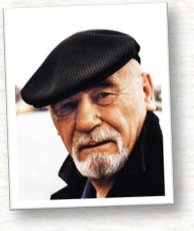
Brian Jacques

As an endnote, the Redwall series author Brian Jacques died.  I had planned on writing this blog for a while now, but his death provided the impetus.  He wrote 21 novels in the series over the last 25 years.  He kept adding to his world and mythology, the world and mythology that captured my heart.  When I saw Redwall trending on Twitter, I realized how many other people he effected.  His writing inspired many to read.  I'll let them speak for themselves.  
@thebookmaven "RIP Brian Jacques. His delightful REDWALL series has, does, and will bring joy to so many young readers." 
@fridgebuzznow "Brian Jacques died? The Redwall books rocked my elementary school world!" 
@bsharbaugh "Very sad. Formative books for me." 
@busmute "Redwall fostered compassion in me before I ever knew the name of Jesus. Brian Jacques will be sorely missed, by me, at least." 
@micahmoreau "Sad day - Brian Jacques died. Matthias of Redwall was my hero for a little while. In related news, my hero happened to be a mouse."
"Redwall is where safety and warmth surround you. Food, friends, music and song. Redwall will always welcome you back."  

Wednesday, February 2, 2011

O Candlemas Candle, O Candlemas Candle

Being that it is the Feast of the Presentation of the Lord in the Temple, or to some, Candlemas.  I thought it would be appropriate for a hymnodic reflection.

Hail to the Lord who comes,
Comes to his temple gate,
Not with his angel hosts,
Not in his kingly state;

But borne upon the throne
Of Mary's gentle breast;
Thus to his Father's house
He comes, a humble guest.

The world's true light draws near
All darkness to dispel,
The flame of faith is lit
And dies the power of hell.

Our bodies and our souls
Are temples now for him,
For we are born of grace--
God lights our souls within

O light of all the earth!
We light out lives with thee;
The chains of darkness gone,
All sons of God are free.

John Ellerton, 1826-1893

Taken from the hymn for Morning Prayer for the Feast of the Presentation

Monday, January 31, 2011

Unplanned, a Second View

I have read many different types of books.  No type of book, other than Scripture, has moved me as much as the confession.  The first time I read St. Augustine's confessions I was in awe at his self-reflection and his honesty.  I have not read another in this genre (I believe it has very few constituents) until I read Unplanned by Abby Johnson (also see the Curt Jester's review of the book, of which I linked earlier this month).  Most might not put said book in the genre of confession but rather in the broader genre of say, autobiography, but I would beg to differ, due to the content and the general thrust of the work.  Abby Johnson is downright candid in retelling her experience, with the help of experienced writer Cindy Lambert.  The clarity with which she conveys her emotions is profound and moving.  She has been through quite an experience over the last few years.  Multiple times I found myself tearing up, in sorrow or in joy, sharing with her the pain, the suffering, and the joy.  

Like Augustine, she has been able to piece together how God has worked in her life to bring her where she is.  Her confession is a testament to God's providence and His gentle tenacity for the sanctification of lost souls.  Abby indeed was lost in the lies a Planned Parenthood.  Although she didn't say it, out of great love and care for her co-workers, one cannot help but see in many who work at PP the old familiar phrase, "the road to hell is paved with good intentions."  Her intentions were very noble and nothing but genuine.  They were used for very unnoble and nothing but false means, the procuring of abortions for many women.

She captured the humanness of people on both sides of "the fence."  One can tell she made a deliberate point not to demonize those at Planned Parenthood.  She rather showed us all that when one is treated humanly, even if on the wrong side of the fence, one can understand the error in which they live.

I suggest this to anyone who works with the pro-life movement.  It is enlightening and encouraging.  Abby is what some might call a super-save.  She no longer assists Planned Parenthood in procuring confused and misinformed women abortions.  In turn, she now quietly and gently urges and prays for those confused and misinformed women to not have an abortion.

As a final note, I would suggest this to all seminarians and priests.  Because of Abby's candidness, one can really see the movements in her soul.  One can see the influence of evil spirits and good spirits.  One can see how the evil spirit depresses her once she makes a choice for good and how the good spirit encourages her on.  One can see the good spirit biting at her through her parents and her husband.  This is a great book to read to begin to understand what a soul, that we might be directing, goes through.

QWERTY and the Spiritual Principle of the Human Person

I am sitting in a coffee shop doing some paperwork for the seminary and found myself staring off into space while typing.  I wasn't looking at the screen or at the keyboard.  I was just typing what I thought, as I am right now.  It hit me how amazing a skill tying is.  Letters are not in alphabetical order.  They are in QWERTY setup, and yet my brain in conjunction with the small appendages attached to my hand connected the keys so as to make words.  This is utterly amazing.  I shows to me the beauty of the human person how so.  I shows both mental and muscle memory, which granted is not a necessarily exclusive human ability.  However, what the muscle and mental memory is used for is creating words on a screen that connect together to make sentences and ideas.  Symbols such as "t" and "j" and ";" help communicate invisible realities such as thought, and justice, and the clarity of context.  These invisible realities in turn connect the perceptible reality of words with the spiritual principle of the human person.  By me typing this entry, I am communicating a spiritual reality.  Who said the typist couldn't be a philosopher?

Thursday, January 27, 2011

Pellas Apollo and Paper Dolls

As I write these words, I sit at the desk of my new job: copy boy. I join the generations of proud copy boys whose noble feet have moved our civilization forward since the invention of the Gutenburg Press. I’m afraid that it is their skill and effort that will fuel our civilization till the Apocalypse recounted by that first printed tome: the Gutenburg Bible.

Sitting here in this room, meditating on these topics of respectful work and working revelation, a rather flippant thought comes to me. It has haunted me for some time yet I have never put down into writing. It first popped into my head thanks to Dunder Mifflin and The Office, it was confirmed by St. John of the Cross during my time in the Monastery and, as I sit stationed surrounded by stationary, it occurs to me that there might indeed be an omen in this strange situation. Is it possible that we worship paper? Have we have enshrined it in the way the ancient worshipped the wheat in worshipping Baal, or exulted mere sex in the shrines of Venus? If what man worships is essentially what he spends the most time with, than the Philistine worshiped the field, the Roman worshiped power and lust, and we worship these things indirectly through paper. And not just paper. I include media of any sort under this umbrella: TV, radio, internet etc. But our worship is of an insane sort.. While it is true that men can be tempted to live by bread alone, or that they can be convinced that fertility is necessary for the progress of civilization, it is our own backward 21st century that would insist that life is dependant on print and media. Imagine telling a solemn Philistine, who’s spent his whole life laboring under the delusion that he should worship the god that brings nourishment through food, that all his years have been wasted. Reaping is nothing, we would tell him, in comparison to a reem of 8x11 canary paper. See the proud Roman centurion. Try telling him that his greed for wealth and women, born of the desire for food and children, are really second to the need for Facebook. Our idols are not wood and stone, but paper dolls.

If there are any regular readers of my bloggings, (and I do thank you for your loyalty) they might have realized that I like this exercise of contrasting contemporary culture with the ancients, especially the ancient pagan. I do this because I believe that we live in an era of Neo-Paganism (which should not strike you as a surprising concept) and because I believe that we are far worse off than the original pagans (which should be an unsettling concept). Now, I’m not so backwards so as to assume that things were best under Caesar and Pilate, or that they were perfect in the days of Leopold or Leo. I do not idealize the past. There was famine. There were needless wars and petty politicians. There were sinners and saints, but at least they were sane. I use this admittedly extravagant metaphor about the cult of copy-paper to point out a strange and bewildering fact about contemporary life. We are indeed wanton and wasteful, but not in the way our forefathers were. They might have treated the field with a certain amount of idolatry and women as if they were waste, but we moderns have outdone them in according waste-paper with respect and relish. We’ll spend the same time and energy indulging in media, be it printed or electronic, that an honest heathen spent in wandering in the fields and frolicking in the city.

Even our concept of labor is tainted by this petrifaction of communication. Across this country, we claim that ‘doing work’ consists of moving paper across desks. Our business men and women don lavish garb to perform this exercise. I am not criticizing those men and women. I have great love and admiration for many of them. I know that they suffer a great deal of stress and make great sacrifices so as to distribute information and keep the wheels of commerce moving. My question is not with their skills or service, but with their product. Or, as GKC would say, I wonder whether or not there search for goods is really a search for the Good. Were the apocalypse (Zombie, Nuclear, Terrorist or otherwise) to happen tomorrow, there would be few ‘usable goods’ left after all the paper had burned. More tragic still, there would be fewer people with enough practical knowledge and common sense left to know what to do with a fruitful field or a pregnant woman. People of this age complain of feeling disconnected with reality and my immediate thought is that they are quite right. They have placed a veil between themselves and the fruits of creation. It is an irony of fate that the veil if made of paper or, better yet, of a computer screen.

Reality is indeed all around us, but it doesn’t flash or bang or come in a cool font. Our Benevolent Father has given us a glorious gift. Sometimes, we choose to revel in the wrapping paper instead savoring in the quietude of His beatitude. And, in the silence of this creation, He is trying to speak to us. When this silence gets awkward (like in a copy room at 9:00am), I feel as if He is on the verge of saying some important thing.

Wednesday, January 19, 2011

Music Done Well

As of late, I have been reading St. Augustine's treatise, On Music.  A later blogpost will give my thoughts on the whole work but one particular part in the first of the six books interested me.

He said, "Music is the science of moving well."  As a means of necessary background, this particular treatise covers rhythm only so the definition fits well in that regard.  He goes in that chapter to make a point of the qualifier "well."  Well does not just connote the good measuring of notes at time and intervals that are pleasing to the ear; it also connotes the proper place in which those notes are heard.
Yet it is possible for this harmony and measuring to please when they shouldn't.  For example, if one should sing sweetly and dance gracefully, wishing thereby to be when the occasion demanded gravity, such a person would in no way be using harmonious mensuration (correct measuring of notes) well.  In other word, that person uses ill or improperly the motion at one time called good because of its harmony. (On Music 1.3)
There is not only good mechanics and sound but a proper place for those good mechanics and sound.  Good music is not harmony and rhythm alone, but proper placement of that harmony and rhythm.  One wouldn't play, for instance, speed trash metal during the bridal procession of a wedding.  That particular harmony and rhythm, although good in itself (some may argue otherwise), does not fit with that situation.  Now I know people push these boundaries.  The 20th and 21st centuries have been all about pushing boundaries in art, but it is boundaries, i.e. harmonics and rhythms that internally control music.  Aharmony and arhythm is not music.  It is noise, a cacophony of sound with no order.  What to me, Augustine is proposing, is that not only is the order of harmony and rhythm part of music but the placement of that harmony and rhythm within a given situation.  A director would not set "Flight of the Bumblebee" during a peaceful scene with the couple walking down a beach at sunset.  It does not fit the mood.  In our insides we naturally recognize the incoherence of that.

There also occurs in our hearts and in our senses a certain deadening of that naturally recognizable incoherence when incoherence becomes the norm.  Coherence can no longer be identified.  Say for instance someone cannot tell the dream from reality.  One actually is reality and the other a figment of imagination.

This seems to have occurred in Liturgical music over the past half century.  People recognize beautiful music and wish to incorporate it into the liturgy because of its beauty, which is indeed an admirable desire, but the second part of what Augustine describes as good music requires proper placement.  Although pop music has recognizably coherent harmony and rhythm that is pleasing to the ear, it does not fit within the framework of worship.  Pop music is an earthy, passionate, and highly emotional form of music.  It keeps one firmly in earthly experience.  It does not, but its mood and movement lift someone  up to worship in God the same way the other-worldly sound of Gregorian Chant, or Mozarabic Chant, or Byzantine Chant does.  Chant lifts someone out of themselves and moves the towards God.  The lack of meter gives a certain elevation to it.  It is guided by accents and phrases connecting lyric with melody in such an extraordinarily symbiotic way.

I'm looking at this from a philosophical viewpoint, but it would seem that this viewpoint finds its way into countless church documents about sacred music.  Corpus Christi Watershed does a good job of explaining it here:


Can you tell the difference?? from Corpus Christi Watershed on Vimeo.