Tuesday, January 10, 2012

Happy Priests!

A few weeks back, my bishop sent me and my brother priests in the diocese a copy of Msgr. Stephen Rossetti's book entitled Why Priests are Happy. Having benefited from reading two of his previous works, I was happy to have this newly-released book that looks at the state of my brothers in ministry. 

I found the book to be enjoyable, despite the fact that it was really a summary of a two large-scale studies of priestly life and ministry, which arrived at conclusions via charts and numerical analysis. I found it particularly interesting to see his findings on the connections between priestly happiness, time in prayer, various spiritual practices, understandings of obedience and celibacy, as well as other elements with regards to different generations of priests. 

All of these various factors come together to paint a beautiful picture of priesthood, one that show that we priests are ... actually happy! The correlations (not causations, as he clearly notes) between happiness and various beliefs and spiritual practices was also good food for reflection in my own vocation, as it would be for anyone. In the end, he simply notes that as a whole, priests are generally happy, and that the reason is... well, I'll leave that for you to find out.

Friday, January 6, 2012

Friday Thoughts - Why Barnes and Noble Makes Me Sad

Unfortunately, there is much poor representation of the Catholic Church on shelves of people who like myself grew up with poor Catechesis. One such book might be The Pope's War by Matthew Fox. To boot, Barnes and Noble is selling the nook book version for $4. A cheap 'Catholic' book!


I know should expect this from such a corporation. I know I should expect this from secular media controllers. I know I should expect this from men who are angry at the Church and have an axe to grind. I still need to come out of the naïve mindset that if I treat someone with Christian love and desire to receive that back in turn, I will not necessarily receive it. Nope. That's not what's happening in this world.


I desire for people to know Truth and Matthew Fox comes 'revealing the truth' about the corruption of the papacy for
the last 25 years. To say there hasn't been corruption among successors of the apostles, among priests, deacons, religious, would be to lie. He doesn't target those who rightfully should be targeted for their sad representation of men and women called by God to serve the Church. No, he targets righteous men! Righteous men!


I feel in need of a psalm of lamentation.

Thursday, January 5, 2012

Top Ten Books Read in 2011, #1

Finally, what everyone has been waiting for, the number 1 book read in 2011 is ...
Leisure The Basis of Culture by Josef Pieper
There are books. There are great books that you will always remember. And then, there are books that change the way you view the world. Josef Pieper's philosophic classic did that for me. You would have been a follower for this blog for over year to remember my postings on this book in late 2010 (there are too many to link). I finished the book in January of 2011, and it set the tone for my whole year.

Pieper's basic concept is that we misunderstand what leisure is. We think of leisure as vacation, time away from work, time doing things we want to do. Leisure isn't time. It isn't a suit. It's a way of living. It's a way of looking at the world. Simply put leisure is the reception of truth, good, and beauty. It is philosophic contemplation.
(Deacon Kyle your losing me)
I think I just lost myself. Sorry.
To be in leisure is not be bound by work and dominated by work, enslaved by work. Work is not what defines the human person (although his work is dignified). The human person, first and foremost, is created in the image and likeness of God. He is both body and soul. Leisure is reception of the divine in ordinary circumstances. It's celebrating at the beauty of a child running in joy at the return of her father from business trip. It's seeing and contemplating the revelation of the divine in the mundane activities of the day.

Work, if divinized, blinds one from seeing the divine in washing dishes or sitting smoking a pipe in the nice cool air on a fall day. Divinized work has one end, productivity. Productivity without the final end in mind, i.e. celebration in the full presence of the divine in heaven, destroys a proper understanding of the human person. He/she becomes a means to an end, when God says, love as I love, without condition, without the need for response, without ulterior motives, just cuz.

No matter your background. No matter your reading level. No matter how much you read. If you read any book in 2012, it should be this book. End of story. End of list. Can't wait to find out what good reads I will encounter this year.

Wednesday, January 4, 2012

Top Ten Books Read in 2011, #2

Number 2 is ...

And Then There Were None by Agatha Christie
Again, this has been a year of firsts. I have have always been a fan of mystery fiction and was fully ashamed that my only familiarity with Agatha Christie was a high school drama club rendition of The Mouse Trap (which coincidentally was done very well and probably helped insight my love of mystery fiction). Yes, sad, again ... So when I became a member of Audible via my friends over at Catholic Underground who were offering a one month free subscription the first audiobook I bought was And Then There Were None.

I can see without a shadow of doubt having read about 5% of the full corpus of detective and mystery fiction that this is the best book of them all. It has fantastic characters that you immediately hate and learn to love. It has a twisting plotline with a simple ending that literally blows your mind. It is able to be a mystery story where the possible culprits are at the same time the detectives. It follows a nursery rhyme. I mean you can't get better writing in this genre. If you haven't read this, read it. This year. You can find at your local bookstore or e-book store. It is worth your time hands down.

GKC and the Largeness of the Faith

Yet another GKC read! 

This could be considered his commentary on John 6: 68; "To whom, Lord, shall we go." Specifically, he is defending to freedom of the faithful, that when they come to Christ, He enlarges their freedom rather than dismantling it. 

Nothing is more amusing to the convert, when his conversion has been complete for some time, than to hear the speculations about when or whether he will repent of the conversion; when he will be sick of it, how long he will stand it, at what stage of his external exasperation he will start up and say he can bear it no more. For all this is founded on that optical illusion about the outside and the inside which I have tried to sketch in this chapter. The outsiders, stand by and see, or think they see, the convert entering with bowed head a sort of small temple which they are convinced is fitted up inside like a prison, if not a torture-chamber. But all they really know about it is that he has passed through a door. They do not know that he has not gone into the inner darkness, but out into the broad daylight.  It is he who is, in the beautiful and beatific sense of the word, an outsider. He does not want to go into a larger room, because he does not know of any larger room to go into.  He knows of a large number of much smaller rooms, each of which is labelled as being very large; but he is quite sure he would be cramped in any of them. Each of them professes to be a complete cosmos or scheme of all things; but then so does the cosmos of the Clapham Sect or the Clapton Agapemone.  Each of them is supposed to be domed with the sky or painted inside with all the stars. But each of these cosmic systems or machines seems to him much smaller and even much simpler than the broad and balanced universe in which he lives.  One of them is labelled Agnostic; but he knows by experience that it has not really even the freedom of ignorance. It is a wheel that must always go round without a single jolt of miraculous interruption--a circle that must not be squared by any higher mathematics of mysticism; a machine that must be scoured as clean of all spirits as if it were the avowed machine of materialism. In living in a world with two orders, the supernatural and the natural, the convert feels he is living in a larger world and does not feel any temptation to crawl back into a smaller one. One of them is labelled Theosophical or Buddhistic; but he knows by experience that it is only the same sort of wearisome wheel used for spiritual things instead of material things.  Living in a world where he is free to do anything, even to go to the devil, he does not see why he should tie himself to the wheel of a mere destiny. One of them is labelled Humanitarian; but he knows that such humanitarians have really far less experience of humanity. He knows that they are thinking almost entirely of men as they are at this moment in modern cities, and have nothing like the huge human interest of what began by being preached to legionaries in Palestine and is still being preached to peasants in China.  So clear is this perception that I have sometimes put it to myself, as something between a melancholy meditation and a joke.  "Where should I go now, if I did leave the Catholic Church?"  I certainly would not go to any of those little social sects which only express one idea at a time, because that idea happens to be fashionable at the moment. The best I could hope for would be to wander away into the woods and become, not a Pantheist (for that is also a limitation and a bore) but rather a pagan, in the mood to cry out that some particular mountain peak or flowering fruit tree was sacred and a thing to be worshipped.  That at least would be beginning all over again; but it would bring me back to the same problem in the end. If it was reasonable to have a sacred tree it was not unreasonable to have a sacred crucifix; and if the god was to be found on one peak he may as reasonably be found under one spire. To find a new religion is sooner or later to have found one; and why should I have been discontented with the one I had found? Especially, as I said in the first words of this essay, when it is the one old religion which seems capable of remaining new.  I know very well that if I went upon that journey I should either despair or return; and that none of the trees would ever be a substitute for the real sacred tree. Paganism is better than pantheism, for paganism is free to imagine divinities, while pantheism is forced to pretend, in a priggish way, that all things are equally divine. But I should not imagine any divinity that was sufficiently divine. I seem to know that weary return through the woodlands; for I think in some symbolic fashion I have walked that road before. For as I have tried to confess here without excessive egotism, I think I am the sort of man who came to Christ from Pan and Dionysus and not from Luther or Laud; that the conversion I understand is that of the pagan and not the Puritan; and upon that antique conversion is founded the whole world that we know. It is a transformation far more vast and tremendous than anything that has been meant for many years past, at least in England and America, by a sectarian controversy or a doctrinal division.  On the height of that ancient empire and that international experience, humanity had a vision. It has not had another; but only quarrels about that one. Paganism was the largest thing in the world and Christianity was larger; and everything else has been comparatively small. 

Tuesday, January 3, 2012

The Hazards of Incense or How Not to be a Sick Christian

I love incense. It's one of the greatest parts of the Roman liturgy. The symbol of the cloud and smoke as the presence of God is tangible. It gives the liturgy mystery. It clouds the holy of holies like the type of heaven, the Temple, letting the whole congregation know God is present.

It is also a symbol of prayers rising to God. "Let our prayers rise like incense," a psalm says, "like an evening oblation." Such beauty, such majesty dwells in the scented smoke pregnant with such symbols.

Unfortunately, on Christmas Eve, my ideals of smoke where sent crashing to the ground. During the gospel, I was so surrounded by incense, sight became difficult. Tears streamed from my eyes. Nausea set it. I used every bit of control I had of my body to not interrupt the liturgy. All turned out okay from a liturgical standpoint. I however was rendered sick.

This is the thurible in the Cathedral of Santiago de Compostela. I felt like the guy in red.
You see, dear reader, I'm allergic to every tree and grass pollen in the US, dust mites, mold spores, and, yes, smoke, even the kind with great symbolism. The heavenly cloud brought me close to earth. Over the last week my schedule didn't let up and neither did my sinuses. The build-up of sickness and weariness came to a head Friday. Saturday morning I woke up incapacitated. Three days I have been laid up finally "resting", for the first time, since ... well, I can't remember.

Instead of taking advantage of the infinite possibilities of redemptive suffering, I wasted my weekend away in half-rest. Never fully resting in the sense Pieper speaks of, I distracted myself from the pain and suffering through various media, film, football, video games. Not spending time in thought, prayer, preparation for blogs, or even for the two retreats I'm working the next two weekends.

Part of resting is contemplation and meditation. Escape is not rest because all you're doing is running away. Encountering Him who is rest, contemplating His mysteries eases the soul. When the animating principle of the body is at ease, the body itself is set at ease. We've all been witness to the sick person or dying person who contemplates. They seem to rest easy; they share their inner life with greater clarity.

So, dear reader, next time you're sick, contemplate, meditate, on the divine Passion, on the Sacred Heart, on the Immaculate Heart of Mary, don't escape to media, books, whatever, to keep your mind off the sickness. (I'm not saying don't read, but rather, don't read to the neglect of the great opportunity of meditation you have at that moment) Instead, turn and face Christ in the clouded mystery of your heart, because it is there that He dwells. It is there that we will meet Him. It is there the healing will commence.

Top Ten Books Read in 2011, #3

Kind and patient readers, I apologize the incompletion of this series. I intended to write three and two on Friday and number one on Saturday and an illness caught up with me.

Number 3 is ...

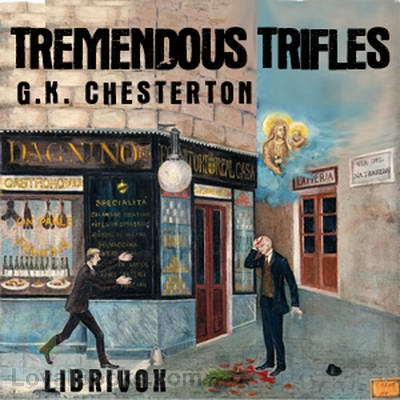
Tremendous Trifles by G.K. Chesterton
It's not often that I read a collection of essays. Being that this was my first year reading Chesterton (shame, Deacon Kyle, shame!), I figured I'd go with what had been recommended to me. This was recommended to me by one of our fellow writers on the blog (who has been overly busy to write). He told me he reads this over every year. Therefore, I had to read it. The essays were fantastic. Chesterton's wit shone through but more importantly, it provided me with a necessary outlook change. One can find the good, the true, and the beautiful in the ordinary circumstances of life, whether they be brown paper bags and white chalk, or travels to unknown towns, or taxi ride. Chesterton's intellect shines forth in his ability to see the underneath of the material happening. Things are much deeper than they seem.